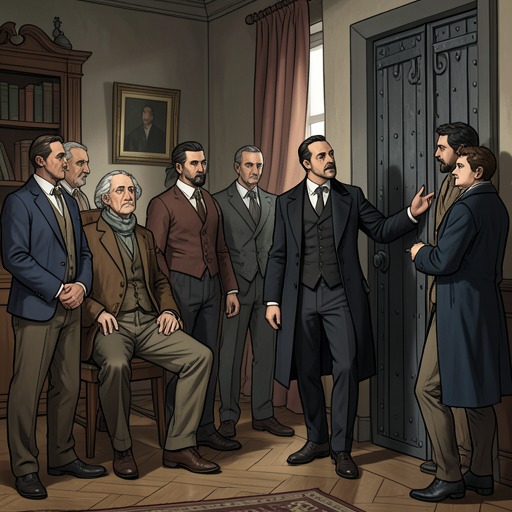
Social snobbery and hierarchy
In Search of Lost TimeSocial snobbery and hierarchy are presented as a changeable social system whose authority depends on both inherited rank and the fragile, public signs that make rank legible. Invitations, introductions, forms of address, political associations, money, and artistic reputations all help determine who belongs; none offers a permanently secure position. In gatherings from the Guermantes drawing rooms to the salons of Odette Swann and Madame Verdurin, ceremonial manners can reinforce rank, while a changed fashion or a strategic absence can overturn it.
Rank, Manners, and Social Performance
At the Princesse de Guermantes’s parties, social authority is exercised through an apparently gracious innovation. Rather than remaining fixed among guests, the Princess moves between small groups of chairs, draws people into conversation, and makes introductions. The ritual seems spontaneous, but its regular circuit displays her command of the gathering: each group receives her attention, and her movements make the skill of the great hostess visible. Sociability is therefore not simply a matter of friendliness; its choreography turns control over attention into a mark of rank.
The usher’s announcement of the Duc de Châtellerault makes the same system audible. At a private encounter in the Champs-Élysées, the Duke had concealed his identity behind the claim that he did not speak French. At the Princess’s house, the usher recognizes him and, after the Duke gives his name, publicly expands it into a full princely style. The Duke recognizes the usher and realizes that his earlier incognito has been exposed. The exchange shows how a name can convert private identity into public standing, and how a servant’s command of heraldic forms can magnify a guest’s rank before the assembled company.
The Princess’s conduct toward her servants offers a contrasting model of hierarchy. At the hotel, she gives generous tips and addresses Aimé, the wine waiter, and the lift-boy with friendly remarks, behaving as though they were attending on her personally. Her sovereign assurance makes her act as host even away from her own house: she treats the setting as a place where she is entitled to extend hospitality. The narrator relates this to the custom that a sovereign is at home wherever present, a principle conventionally expressed by a host carrying his hat in his own house. Her courtesy softens the visible distance between princess and employees, but it also displays the confidence of someone whose rank is never in doubt.
Exclusion, Reputation, and the Press
The Saint-Euverte salon demonstrates the distance between reported prestige and effective social standing. Madame de Saint-Euverte has transformed a gathering once likened to a social leper colony into a party attended by prominent figures, yet the presence of eminent guests does not make her house genuinely fashionable. Many attend after entreaties and favors, feeling they are conferring an honor. Meanwhile, a truly sought-after hostess may invite only a few people and leave no guest list for the newspapers. Society columns can thus make a salon appear supreme to readers who know social life only through print, while the most exclusive gatherings escape that public accounting.
The Guermantes circle’s refusal to attend makes the distinction concrete. The Duchesse de Guermantes explains that she will miss the Saint-Euverte party because she has at last decided to see the stained-glass windows at Montfort-l’Amaury, a visit she has postponed for more than twenty-five years. M. de Bréauté understands the excursion as a social judgment: her absence marks the house as respectable enough to be reported but not as a place where a person of her standing should appear. M. de Froberville, by contrast, can scarcely contain his delight at the hostess’s disappointment. The same snub therefore functions as a declaration of rank for one group and as a comic triumph for another.
The narrator observes that the consequences of an invitation are magnified by people’s dependence on social success as a measure of personal worth. A party may be announced in the newspaper only after the fact, when those omitted begin to wonder why they were excluded. Some exclusions follow the influence of Palamède de Charlus, who has socially excommunicated people whom the Princess might otherwise invite. Even an invitation does not guarantee that a guest has been included through genuine intimacy: the Princess’s gatherings can erupt unexpectedly and bring in people whose existence she had forgotten for years. Inclusion and omission are thus treated as verdicts, though their causes may be accidental, tactical, or controlled by someone other than the hostess.
Salons in Historical Motion
The novel rejects the idea that social standing can be understood as a permanent arrangement. A salon changes along with the period’s intellectual and political interests: people seeking novelty may turn from hostesses whose influence has become familiar toward a newly discovered circle that promises access to fresh ideas. Some apparently new hostesses have entertained a few chosen friends for years before the fashionable public notices them. A salon’s rise may therefore be less an abrupt personal transformation than a delayed recognition, as the surrounding social world finds a new use for it.
The comparison among Madame Swann, Madame Verdurin, and the Guermantes circle shows different sources of attraction and prestige. Madame Swann’s salon is associated with Bergotte and the literary attention his work commands; the Verdurin circle becomes a lively centre of the Dreyfus crisis, while the established Guermantes entertainments seem increasingly unchanged. The narrator places these shifts alongside broader movements in artistic taste and political life. Social gatherings do not mirror such changes precisely, but they echo them unevenly, as fashion and public curiosity alter which people and ideas seem compelling.
The press intensifies the gap between a salon’s actual relationships and its public image. People who have never visited Madame Swann may imagine that her guests are obscure, in part because she avoids advertising her connections and because society often mistakes the absence of newspaper notices for the absence of invitations. When Princesse d’Epinoy visits to collect subscriptions for the Patrie française, she expects an unimportant gathering but finds prominent women and aristocratic men attending Madame Swann. Some of the men had first come privately to meet Bergotte; discreet dinners and visits to notable theatrical premières then helped introduce Odette to women receptive to novelty. The salon’s rise proceeds through selective, largely unpublicized encounters before its status becomes visible to a wider audience.
That delayed visibility culminates at a charity rehearsal of a play by Bergotte. Madame de Marsantes and the Comtesse Molé, who is becoming the leading society figure of the age as the Duchesse de Guermantes withdraws from that role, appear in the author’s central box beside Madame Swann. Onlookers recognize that Odette has climbed without their having noticed the stages of her ascent. The scene makes the social column’s limits plain: public observers learn to name a change in position only after private relationships and choices have already brought it about.
Inherited Rank, Money, and Reversals
The history of the Marquise de Surgis-le-Duc shows how inherited status and social conduct can pull in opposite directions. Her title’s suffix comes from a bourgeois surname: a Comte de Surgis married the daughter of the wealthy industrialist M. Leduc, and Charles X created the marquisate for their son. The family’s fortune enabled it to form alliances with the leading houses of the realm, and the present Marquise was well-born enough to occupy a high social position. Yet she rejected the position available to her, left her marital home, and lived openly apart from conventional expectations.
The consequences reversed her standing. Society that had once been at her feet rejected her years later; only a few loyal friends continued to greet her, and she had to laboriously recover ground she had once held by birthright. Her return to aristocratic society is not a simple restoration. Recalling childhood connections partly disguises her ambition from herself as well as from others, and her choice of Basin de Guermantes as a lover provokes the women around the Duchesse de Guermantes to rally against her. A social ascent can therefore be reversed by the very networks through which recognition is sought.
Money can also draw attention to a person whose connections had previously counted for less. Gilberte inherits nearly eighty million francs from an uncle of Swann’s, and the Faubourg Saint-Germain begins to take notice of her. Odette benefits both from this wealth and from her gradual association with literary and aristocratic circles. Swann’s Dreyfusard views, which might have been expected to damage his wife’s standing, are dismissed by some as the opinions of a man whose mind has failed. At the same time, his refusal to flatter fashionable anti-Dreyfusards makes his wife more intriguing: his public rebukes of her attempts to approach them attract attention, and invitations arrive. The effect is ironic: a political disagreement that might exclude Odette instead helps make her socially interesting.
Speech, Historical Uniformity, and the Limits of Rank
The social order is also exposed through manners of speech and inherited custom. At the Guermantes gathering, the Duc de Guermantes is angered when his wife greets a Bavarian musician he considers disreputable. His reaction reveals that acquaintance itself is policed: whom a duchess acknowledges can be treated as a judgment on her household and on the people who witness the exchange. The narrator’s earlier reflections on the fading greetings of the Duchesse de Lambresac and his grandmother’s friends place such manners within a longer history. Closed societies preserve old forms of address and greeting, making social conduct a trace of the upbringing and ethos of an earlier age.
Yet distance in time can make distinctions of caste less conspicuous than the shared marks of an epoch. The narrator sees a resemblance between the Duc de Bouillon and a petty bourgeois of his own generation, and recalls that Saint-Loup’s maternal grandfather, the Duc de La Rochefoucauld, resembled his great-uncle in a daguerreotype. Dress and the imprint of a period on faces and manners can unite people whom their own society sharply separates. A nobleman of the Louis-Philippe era may resemble an ordinary citizen of that era more than a nobleman of the Louis XV era. Rank looms largest within contemporary self-esteem and imagination; viewed historically, the uniformity of an age can make those supposed boundaries recede.
The dinner at La Raspelière turns precedence into explicit argument. When M. de Cambremer moves as if to offer Palamède de Charlus his chair, Charlus interprets the gesture as recognition of a prince’s right to precedence. He refuses the seat with emphatic familiarity, saying that such deference is reserved for princes of the blood. Later, he recounts family precedents for Guermantes precedence at court, including disputes over who could kneel on a hassock and the lowering of ushers’ batons before the Duc de Bourgogne. These ancestral examples convert etiquette into a claimed historical entitlement: the right to be first at court is presented as the continuation of precedence established in war.
Other small acts show how social distinction can depend on rules that are unstable precisely because they are so carefully observed. At the Douville-Féterne station, M. de Cambremer turns a franc in the lamplight and asks the coachman whether it is indeed twenty sous, ensuring that the amount of his tip is both correct and noticed. His daughter-in-law’s pronunciation of Saint-Loup with a final consonant is repeated by an admirer until, apparently corrected by people of greater social prestige, she returns to the usual pronunciation and he follows. A coin, a name, or a consonant becomes a test of breeding and social knowledge. The novel’s examples make hierarchy look at once powerful and precarious: its conventions shape recognition, but recognition depends on observers who can revise what counts as fashionable, correct, or worthy of entry.